Grendel's Mother

The Saga of the Wyrd-Wife

Grendel's Mother

Beowulf: Return to the Shieldlands–“Too much black leather and straps”?

The Daily Mail has reported on fans’ disappointment in ITV’s new drama, Beowulf: Return to the Shieldlands. One hilarious comment maintains that there was “too much black leather and straps” in the show.

Here’s the trailer–you can judge for yourself!

And here’s a link to the first episode.

My feeling is, if even a mediocre tv series might bring people to the original poem, that’s a good thing!

Read more: http://www.dailymail.co.uk/tvshowbiz/article-3383258/What-disappointment-Fans-swarm-Twitter-blast-ITV-s-new-epic-drama-Beowulf-Return-Shieldlands.html#ixzz3wJEJ8OPf

#grendelsmotherthenovel

Follow me @medievalwomen


“That was a good class”: Elemental Beowulf — Earth, Wind, Fire, and Water

I speculated to my students that Beowulf could be read in terms of the four traditional elements: earth, fire, water, and air (wind).  I associated earth with the hall Heorot sits on (though it is attacked by Grendel and his mother).  The dragon in the last third of the poem breathes fire.  Water is clearly associated with Grendel’s Mother’s lair–the mere that Beowulf must swim through to find her–and kill her.

One scholar has linked Grendel’s Mother to the fertility goddess Gefion, whom Snorri Sturluson identifies as having been a consort Scyld.
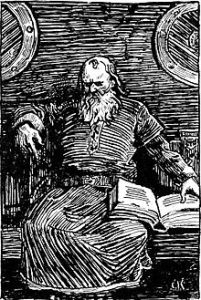
“Snorri Sturluson” by Christian Krohg (1890s)

“Snorri Sturluson” by Christian Krohg (1890s)

Frank Battaglia argues for a shift in the first millennium in South Scandinavia from the bog to the hall for the performance of religious rituals[i] and to a “new kind of coercive authority.”[ii]   The shift to a male deity[iii] from a female goddess, Battaglia argues, is latent in the text. “Grendel wanting to mark his bog retreats (450), sounds exactly like a ritual the poem is declaring to be forbidden, the use of bogs as religious sites.”[iv] It would also suggest that Grendel’s mother functions as a reminder of this natural earth goddess who is associated with watery places. The shift from natural areas to built architecture for sacred rites suggests the coming dominance of “culture” over “nature.” You can read one of Battaglia’s articles here: Battaglia Grendel_s Mother Earth Goddess


While I was musing with my students, I had a real problem deciding how wind was part of the text.  My brilliant student, Dominic, said, “The wind is in the sails that bring Beowulf’s ship to the Scyldings.” Of course!
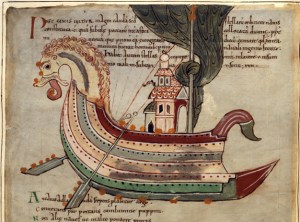
11th century image from the Anglo-Saxon Chronicle

11th century image of a Viking long ship

This is why discussion is so important in class.  Insights are not generated by professors simply lecturing, but pondering with students.  Together, we discover insights into a wonderful poem like Beowulf.

Instead of “That was a good king,” we can say, “That was a good class.” When students and the professor learn.

[i] As identified by Frank Battaglia, 54. He sees her as challenging Beowulf in the sea contest.

[ii] Battaglia, 60. “Gefjun breaks away completely from this pattern of sex roles [wherein mean were free to cross social barriers to choose their sexual partners, women were not], and acts like the male gods. Could these associations the scalds did not want to evoke when they chose not to use her name? A result of that choice could if so be that her memory faded.” Else Mundal, “The Position of the Individual Gods and Goddesses in Various Types of Sources-with Special Reference to the Female Divinities,” in Old Norse and Finnish Religions and Cultic Place-Names, ed. Tore Ahlbäck (Donner Institute for Research in Religious and Cultural History: Åbo, Finnland, 1990), 294-315, here 309.

[iii] “The Beowulf poem, too, in a similar development [to Eddic poems] shows fate as controlled by one male deity.” Battaglia, 57. Of course, I see fate and God as quite distinct entities.

[iv] Frank Battaglia, “”Not Christianity versus Paganism, but Hall versus Bog: The Great Shift in Early Scandinavian Religion and Its Implications for Beowulf,” abstract in Old English Newsletter 34 (2001): 3 A51-52.

#grendelsmotherthenovel

Follow me on Twitter: @medievalwomen

My Amazing Students, Part 4: Old English Environmental Concerns–Can You Guess the Riddle?

My student, Turney, took the Old English riddle form and turned it into a plea for protecting the environment. Along the way, he created these beautiful images of Texas wildlife and nature. See for yourself!

One man’s heaven is another man’s hell
It’s final depth is unknown
Many species have not grown
Until the adventurer’s ring the bell
with a glorious story to tell

I seek to discover the inner space of caves,
the dark depths at the thermocline of lakes,
cracks at seas where the world shakes,
oceans underneath the highest waves,
through rivers where no one behaves.

I am not here to destroy
I am here to protect
Without me there is no generation next
Sustainability is what I employ,
and I will pass it onto my future boy

Without me there is no waste that we shall see
We have polluted our waters
For our next generation’s fathers
I will show you the disease
of the plastic in our seas

Have no fear my friend
We are together as one,
for the revolution has just begun
All I want is to amend
these waters that are a godsend

Have human’s become the devil’s inside?
Aquatic animals are calling out a cry
Some with no water become dry
It is time to decide
before we commit a global suicide

Who am I?

Thank you for speaking out for our global home!

My Amazing Students, Part 3: Poignant Music and a Beowulf Adaptation

My students never fail to amaze me–with their creativity, brilliance, and insight. Here is Kayleigh’s adaptation of the Old English The Wanderer to the music of Scarborough Fair.

Kayleigh also did a wonderful version of Beowulf, findable at Soundcloud. It is called Beowulf–A Condensed Epic. Please listen–it’s beautiful!  Kayleigh’s lyrics are:

A demon with a snake’s green eye
Has sent too many men to die
And Beowulf sails to their aid
Hence Grendel’s life is sure to end

And in the night with shroud of sleep
Grendel’s evil comes to keep
His reign of terror beckoning
But Beowulf has other plans

And Beowulf does take his arm
As Grendel dies, his honor scorned
His mother weeps her tears of blood
She promises her son avenged

When poor Aschere receives her claws
The hero and his men are off
He kills the hag and Denmark lives
The ocean breeze sends heroes home

When Geatland’s great King Hygelac
Dies when the Schlyfings do attack
Then Beowulf reigns fifty years
On borrowed time, on just a loan

A dragon does forsake his land
And Beowulf and twelve scared men
Take valiant hold of their own fates
And go to fight the beast at hand

But only one of hero’s men
Dear Wiglaf helps him succeed
Release the dragon of its soul
But Beowulf was bitten then

And hence our Beowulf expires
They bury him, their fear his fire
Their future does remain thus bleak
Without their champion to speak.

#grendelsmotherthenovel

Follow me on Twitter: @medievalwomen

A Cave of One’s Own: Grendel’s Mother in Popular Media

One fun activity when you are a professor is getting to meet academics, students, and the general public to share your work, get reactions, and receive inspiration from alternative viewpoints.

Flyer designed by Britt Mize of Texas A&M University

Flyer designed by Britt Mize of Texas A&M University

I had a great time recently at Texas A&M University talking about images of Grendel’s Mother in the popular media, focusing on comics and graphic novels.

Dr. Britt Mize of Texas A&M University.

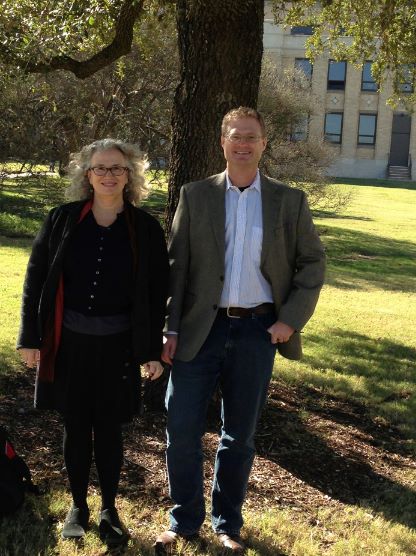
Visiting with Dr. Britt Mize of Texas A&M University on a gorgeous day in December 2015 when I spoke on images of Grendel’s Mother.

I was invited to College Station by Britt Mize, a delightful and erudite Anglo-Saxonist I’ve known for years. Only after I published Grendel’s Mother did I discover his fascination with adaptations of Beowulf. There are hundreds of them: operas, symphonies, comic books, graphic novels, novels, and children’ book, not to mention films.

He shared with me pdfs of many Beowulf comics, from the early 1940’s to the 1970s to just a few years ago.  I discover many interesting things about them that I will reveal in time.  Suffice it to say, I used some feminist theory and lots and lots of images.  The comics occasionally use hilarious dialogue.  They are set in a mythic past or in some futuristic and dystopian time period.

The audience in the English Department had many useful things to point out about the images.  It was really fun. And I got to meet with my dear friend of many years, Dr. Claudia Nelson, a world expert on Victorian and children’s literature.

Dr. Claudia Nelson and me on the campus of Texas A&M. Great to see my dear friend!

Dr. Claudia Nelson and me on the campus of Texas A&M. Great to see my dear friend!

Here is one tantalizing image of Grendel’s Mother to keep you thinking.

From Gareth Hinds brilliant and sumptuous graphic novel.

From Gareth Hinds’s brilliant and sumptuous graphic novel.

Morrison flyer

#grendelsmotherthenovel

Follow me on Twitter: @medievalwomen

Bald’s Leechbook, Staph, Radiolab, and Medieval Cures

Bald’s Leechbook must be the best name ever for an edition of Old English medical charms and remedies. I use a number of these medical recipes in Grendel’s Mother: The Saga of the Wyrd-Wife.

Bald's Leechbook was the preeminent medical text of its day. Image: © The British Library Board (Royal 12 D xvii).

Bald’s Leechbook was the preeminent medical text of its day. Image: © The British Library Board (Royal 12 D xvii). See more here.

I would leave out an ingredient or two just so someone could not replicate such a recipe. Some recipes seem, from our modern perspective, “crazy.” For example, it is suggested that a woman who bleeds too much should find a horse “turd” and put it on a fire; she should stand over it to be fumigated by the smoke. I always wondered how someone would avoid being burned! So I wouldn’t try that at home.

But other recipes and folk remedies may have been efficacious, and not just as placebo effects. After all, a tea made of willow bark is said to cure headaches–aspirin is synthesized from elements occurring in the willow plant. Many recipes involve chanting charms. Music therapy is said to be curative; the charms and their rhythms might have had a healing effect.

A recent Radio Lab story, Staph Retreat, that you can read here, tells a fabulous story.  A scholar in Viking Studies at the University of Nottingham, Dr. Christina Lee, combined her expertise with Dr Freya Harrison, a microbiologist. Dr. Lee translated one of Bald’s recipes, consisting of “a mixture of garlic, onions, wine, and bovine bile salts, all of which were then brewed in a brass cauldron and let sit for nine days.”

  • take cropleek and garlic, of both equal quantities, pound them well together, take wine and bullocks’ gall, of both equal quantities, mix with the leek, put this then into a brazen vessel, let it stand nine days in the brass vessel, wring out through a cloth and clear it well, put it into a horn, and about night time apply it with a feather to the eye.

Doctors Lee and Harrison experimented with a recipe to cure infection.  It turns out, it is a promising antibiotic from the 9th century for MRSA today!

We can learn from our Anglo-Saxon forebears, not just in literature, but medicine as well.

#grendelsmotherthenovel

Follow me on Twitter: @medievalwomen

Roget’s Thesaurus, Heavy Metal, and Grendel’s Mother

I love learning from folks at readings, such as at BookWoman, a supportive and thriving feminist book in Austin, TX where I recently shared Grendel’s Mother: The Saga of the Wyrd-Wife. My old pal Laura asked if I had been inspired to write the novel after becoming a mother.  After thinking about it a bit, I had to say, “Yes.”

I started writing the book in 1998, two years after my daughter, Sarah, was born. We would have a babysitter, Anna, come into the house and play with her while I wrote and worked. Well, by age 2 Sarah had become aware that I was still IN the house.  So she toddled over with Anna into my study.  “I won’t say anything,” little Sarah whispered. As I tried to write, I keep shooting glances over to my dear poppet.  This wasn’t going to work.

That’s when I began my frequent travels to the library at St. Edward’s University, less than a mile from our home.  I brought a laptop with me–a Mac that took dial-up.  So I couldn’t google even if I wanted to.  I simply typed.

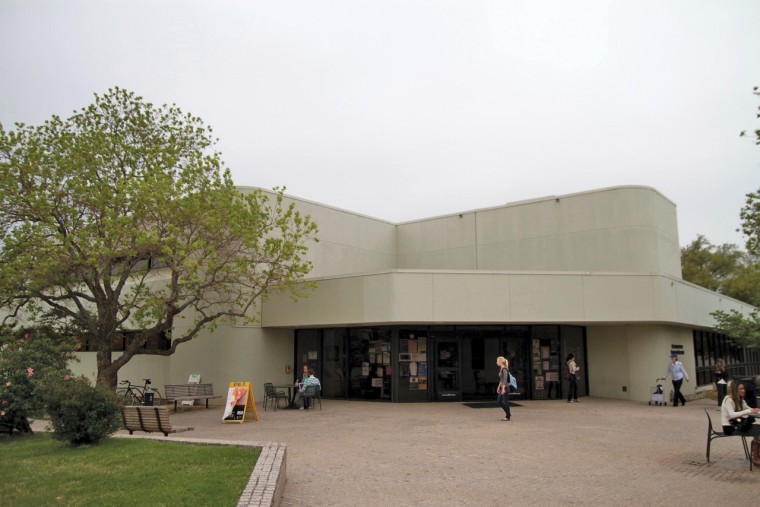
The old library at St. Edward's University. Now they have a beautiful new one. But I have happy memories in the old one.

The old library at St. Edward’s University. Now they have a beautiful new one. But I have happy memories in the old one.

Someone asked me how I got words for alliteration.Then I suddenly remembered my well-thumbed copy of Roget’s Thesaurus.  No googling for synonyms for me!

My well-thumbed copy of Roget's Thesaurus

My well-thumbed copy of Roget’s Thesaurus

Laura’s son, Sam Brancaccio, a brilliant heavy-metal guitarist, might compose music for a song from Grendel’s Mother.  Vikings and heavy metal seem to go together.  So I hope Sam will oblige.  I can see Grendel’s Mother rocking out to his music.

As I left BookWoman, I  found out that a number of women from the “Goddess Group” had bought the book.  I love goddesses!

Just so you know, one scholar thinks Grendel’s Mother is based on an ancient Earth goddess figure. Enjoy!

#grendelsmotherthenovel

Follow me on Twitter: @medievalwomen
The Slave’s Song: As Performed by the Incandescent Sarah McSweeney

Please listen to the incandescent Sarah McSweeney, singer extraordinaire, perform one of my poems from Grendel’s Mother. Rendering a female slave’s poignant wishes as a musical piece, piercing the night with her clear, lucid voice, Sarah invited us into a space of magic and somber eloquence. Now you can hear her sing.

Sarah had the entire audience mesmerized, with tears in their eyes at the book launch for Grendel’s Mother: The Saga of the Wyrd-Wife. Here is the poem as it appears in the book.

I wake

when the moon

still shines on the white-peaked waves.

Sometimes I think that instead of

stoking the fire,

boiling the clothes,

killing the lamb,

tending their every want,

and suffering every shame,

I’ll walk into that water

until I reach my home

across the seas.

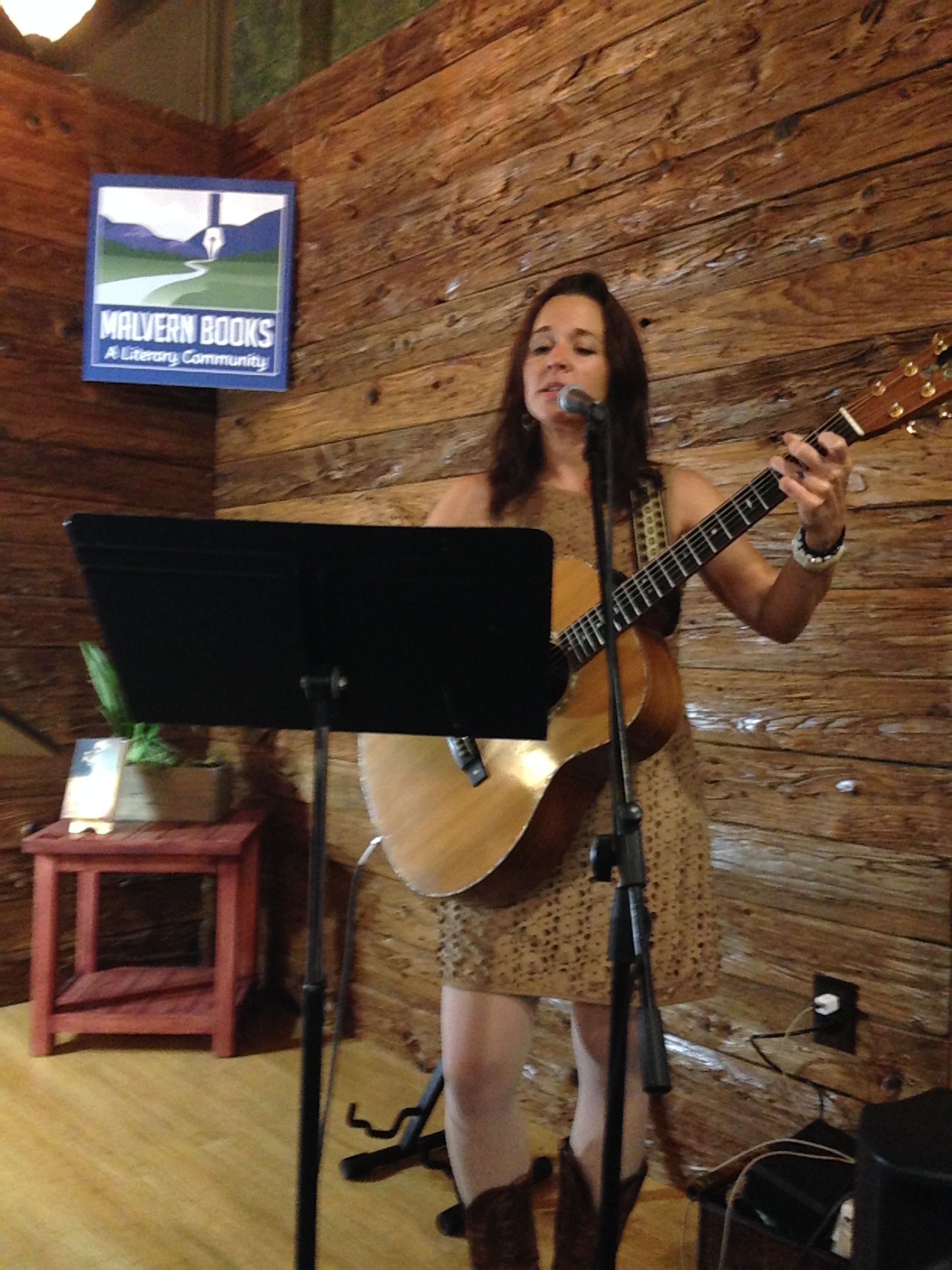
Sarah McSweeney. She is a gorgeous singer: so moving and lyrical. Thank you, Sarah!

Sarah McSweeney. She is a gorgeous singer: so moving and lyrical. Thank you, Sarah! See her website for more information and to hear one of her songs.

Sarah writes about this performance in her beautiful blog post you can read here.  Look at the October 25, 2015 post.

Sarah’s emotion was so genuine, people were utterly moved. The song galvanized the audience. Truly–Sarah has an amazing gift and it’s wonderful she shares it with the world.

Thank you, Sarah, for an unforgettable evening!!  I hope we can collaborate in the future!

#grendelsmotherthenovel

Follow me on Twitter: @medievalwomen

Out of the Tweets of Babes: Nicki Minaj, ‘Miley, what’s good?’ and Unferth in “Beowulf”

What does Nicki Minaj have to do with Beowulf? 14-year-olds have their fingers on the pulse of popular culture.  I rely on my son to keep me up to date. Apparently, there is a Nicki Minaj meme going around with reference to Miley Cyrus dissing Minaj before the VMAs [Video Music Awards].  Then, when Minaj won an award, she said, “Miley, what’s good?” See a clip from the VMAs and a discussion of the aftermath.  Warning of naughty language.

http://www.youtube.com/watch?v=5fbldDmgIvA

So a meme developed in response. You can see countless parodies here (warning: some content contains material not G-rated).

John, studying Beowulf, has adapted it to Unferth, who disses Beowulf on his arrival at the hall Heorot.

John's tweet

John’s tweet

Out of the tweets of babes!

#grendelsmotherthenovel

Follow me on Twitter: @medievalwomen

Travis Heights Art Trail Literary Coffeehouse: Grendel’s Mother and her Friends

I’ll be reading from and signing copies of Grendel’s Mother: The Saga of the Wyrd-Wife and Home Front Girl: A Diary of Love, Literature, and Growing Up in Wartime America at the beautiful Fairview B&B.  This is a new part of the annual Travis Heights Art Trail, a fantastic arts pilgrimage you can take in the most lively neighborhood of Austin, Texas. Well, I would say that. I admit I’m biased.  My favorite folks live in the neighborhood!

THAT_Header

You can look at the schedule for the readings if you want to seek out someone special or download it here: literary-schedule. I’ll be speaking Sat., November 7th at noon and Sunday, Nov. 8th, at 1:30 p.m.

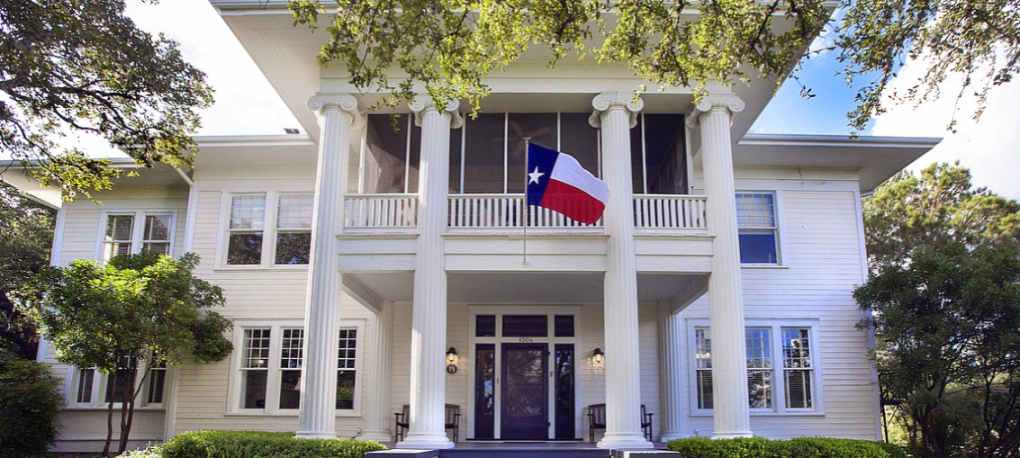
The Literary Coffeehouse will be stationed at the most beautiful home in Travis Heights: the elegant Fairview Bed & Breakfast at 1304 Newning run by the charming couple, Vivian and Jimi Ballard. It was just chosen by the Austin American-Statesman Critics as the Best New B&B.

Screen-Shot-2015-09-27-at-12.00.01-PM-1020x458

The gorgeous Fairview Bed and Breakfast. Totally elegant, totally friendly, totally Austin. Here are directions. This is where our event will be held.

The amazing Laura Cottam Sajbel has let us know where the speakers will be stationed.  While book sales will be set up on the front porch, across from coffee and bakery item sales (YUM!), readings will be around the side of the Fairview, under a live oak, with readers standing on the back porch. Laura is a terrific author herself and will be reading from her new book, Pow Wows and Potlucks: Finding An American Indian Community in Los Angeles (Ethnographics Press, 2015). I’m delighted to be joining her for this event and appreciate all her hard work that went into helping organize it along with many others.

I’m also especially delighted about this event because my delightful new colleague at Texas State University, Cecily Parks, has agreed to read as well.

My new colleague at Texas State University, Cecily Parks

My new colleague at Texas State University, Cecily Parks

Her award-winning poetry will just thrill your soul. You can read more about Cecily if you scroll down on this page.

Cecily's most recent, awarding-winning, book.

Cecily’s most recent book of verse.

I hope you can join us on either Saturday, November 7, or Sunday, November 8, for this fabulous, neighborly, and family-friendly event.

#grendelsmotherthenovel

Follow me on Twitter: @medievalwomen
#